

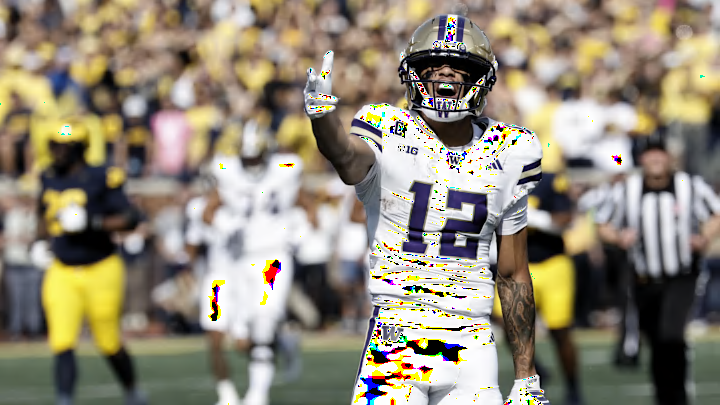
We’re now less than a month away from the 2026 NFL Draft, which means teams are busy assembling their draft boards. Ranking players is all about weighing skills and shortcomings, so today, I’m breaking down the biggest strengths and weaknesses for five former Washington Huskies who I expect to be drafted in April.
Denzel Boston
Strength: Contested catch ability
Wide receiver Denzel Boston stands 6-foot-4 and 212 pounds, which makes him a truly nightmarish one-on-one matchup for all but the tallest of cornerbacks. He earned the nation’s seventh-highest Pro Football Focus (PFF) grade against man coverage (89.7) in 2025, and his eight touchdowns against man coverage were second only to Indiana’s Elijah Sarratt (who scored nine after playing in two additional postseason games).
Boston combines his size with excellent ball skills and strong hands, which makes him an ideal X receiver and boundary threat. He had the nation’s fifth-highest reception rate (72.2%) among FBS receivers with 25 or more man coverage targets.
Weakness: Zone separation
It’s a good thing Boston excels in contested-catch scenarios, because he might find himself in a lot of them as he begins his NFL career. According to PFF, his route separation rate of 32.24% is below the 2026 class average of 32.95%.
He’s had particular issues with getting open in zone coverage: His separation rate on zone coverage of 31.65% is below the class average of 32.52%, as is his separation rate in single zone (42.86% to the class average of 44.76%). His PFF receiving grade also drops from 89.7 against man coverage to a more pedestrian 72.2 against zone coverage.
Boston tallied just two touchdowns in zone coverage in 2025, while opposing zone defenses totalled four interceptions on passes thrown to him. He’ll need to do a better job finding and sitting in soft spots if he wants to be a true WR1 at the next level.
Jonah Coleman
Strength: Red zone production
Running back Jonah Coleman established himself as one of the nation’s most effective red zone threats in 2025. 14 of his 15 rushing scores came from inside his opponent’s red zone (the lone exception being a 26-yarder against Colorado State in Week 1), and 10 came in goal-to-go scenarios.
Coleman’s also a capable receiving option, which makes him even more dangerous in short-yardage scenarios. He had 31 catches for 354 yards and two touchdowns in 2025, and he recorded a reception of 20+ yards in five of the nine games which he played in before his November knee injury.
Weakness: Explosiveness
Coleman’s 5-foot-8, 220-pound frame makes him difficult to stop in short-yardage scenarios, but it also limits his straight-line speed and his explosiveness through gaps. He only surpassed 85 single-game rushing yards twice in 2025, and those performances came in Weeks 1 and 2 against a Group of Five team and an FCS program in Colorado State and UC Davis, respectively.
Coleman hasn’t run a timed 40-yard dash this offseason, which seemingly confirms that speed isn’t his strong suit. There’s no denying the Stockton, Calif. native’s scoring ability, but his lack of straight-line burst could potentially relegate him to a rotational role at the next level.
Ephesians Prysock
Strength: Experience
Former Arizona Wildcats cornerback Ephesians Prysock had more than a year of starting experience under his belt when he transferred to Washington before the 2024 season. He then tallied another 26 starts across two years with the Huskies, which brings his collegiate total to 42 games started across four years.
That experience has given Prysock a keen sense of field awareness and positioning, which could make him a valuable asset in zone coverage at the next level. Prysock’s a long and fluid mover, too, which means he’s usually in the right position to defend passes.
Weakness: Physicality
It’s easy to assume Prysock’s size (6-foot-3, 196 pounds, 33 ½-inch arms) is his greatest strength. However, Prysock didn’t fully capitalize on his gifts in college. He had only two interceptions across three full seasons as a starter, which is perplexing given he’s got the size to dominate 50/50 balls. He’s good in press coverage, but teams expecting a true ballhawk might be disappointed.
It’s a shame Prysock hasn’t made more use of his long frame in pass coverage, because it’s a bit of a weakness in run defense. The senior cornerback is more of a finesse tackler than a downhill thumper. His experience and field awareness mean he usually prevents runs from breaking to his outside, but his thin frame may limit his tackling ability at the next level.
Tacario Davis
Strength: Size
Tacario Davis measured 6-foot-3 ⅞ with 33 ⅜ -inch arms and a 80 ⅞ -inch wingspan–all three positional bests–at last month’s NFL Scouting Combine. At 194 pounds, he’s slightly longer and lighter than Prysock, but he’s a better tackler and a bigger playmaker in coverage.
Davis tallied three interceptions and 36 passes defended across 29 collegiate starts, while Prysock totalled only two interceptions and 20 passes defended across 42 starts.
Weakness: Slow hips
Davis turned more heads at the combine when he ran a 4.41-second 40-yard dash. Unfortunately, Davis’ slow hips at the break point mean he was often unable to deploy that speed in time to prevent completions. Those concerns likely aren't fading, as Davis was visibly slower than his former Arizona and Washington teammate (and other cornerbacks) during hip-flip drilling at the combine.
I thought Ephesians Prysock looked much more fluid than Tacario Davis in the first round of cornerback hip-flip drills. Slow hips are likely Davis’ biggest weakness as a prospect, but he certainly impressed with long speed in the 40-yard dash. #NFLCombine
— Beck Parsons (@BeckParsons3) February 27, 2026
Davis’ hips seriously limited his coverage ability in college, where he earned underwhelming PFF coverage grades of 61.7 and 65.0 during his last two years as a starter. He’s had real trouble sticking with receivers when routes break across his face, and he’ll need to be schemed away from twitchy slot receivers at all costs.
Carver Willis
Strength: Versatility
Carver Willis played 572 of his 574 snaps at left tackle during his one season with the Huskies, but most NFL teams are projecting him to play at either guard or center. He made it clear at the combine that he’s on board with a positional switch, and that he’s accepted the possibility that he begins his career as a depth piece.
Following the combine, Willis’ versatility has clearly helped his draft stock. By Saturday, March 21, he’d tallied an unbelievable 30 in-person or remote visits with NFL teams. Once rated a fringe draft prospect, Willis now appears destined to hear his name called at some point during the three-day selection process.
30 Visits. 👀 @carverwillis75 💪🏽 https://t.co/LJl2PmMgtI
— Washington Football (@UW_Football) March 21, 2026
Weakness: Pass blocking
NFL teams are projecting Willis as a future interior lineman due to his limitations as a pass blocker. His PFF pass blocking grade of 69.2 was well below his very respectable run blocking grade of 84.8.
Willis’ arms measured in at 32 ½ inches at the combine, which is below the 33-inch threshold teams generally have for offensive tackles. While those arms may keep him from ever being a starting NFL offensive tackle, they aren’t likely to give him any issues at guard or center, where his run-blocking chops could prove especially useful.
 Add us as a preferred source on Google