

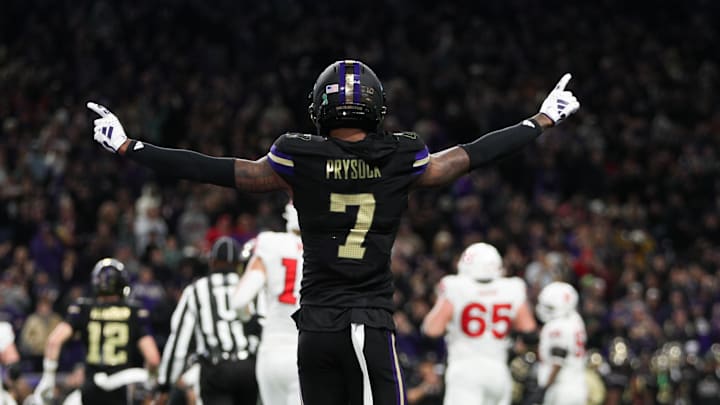
It was a successful NFL Draft weekend for the University of Washington football program. No Huskies were selected in the first round, but by the end of Day 3, the seven Dawgs who made Top-30 visits during the pre-draft process had all heard their names called. Now that all seven former Huskies know where they’re starting their NFL careers, it’s time to decide who’s got it best. Here’s a comprehensive ranking of the 2026 Washington Huskies’ draft destinations.
7. DE Zach Durfee: Jacksonville Jaguars
Durfee was drafted by Jacksonville with less than 25 picks remaining in this year’s draft, so he should be thrilled to earn a preseason contract. But deep down, the former Huskies edge rusher may wish he’d been taken by someone other than the Jaguars.
He’s got no path to starting over two-time Pro Bowler Josh Hines-Allen or former first overall pick Travon Walker, who are under contract through 2028 and 2030, respectively. He’ll likely have to surpass second-year edge B.J. Green II and fourth-round pick Wesley Williams to see even rotational reps.
If Durfee does want to make an impact in his early years, he’ll likely have to do it on special teams. Unfortunately, the 2025 Jaguars were ranked among the NFL’s top eight teams for kickoff return yardage, punt return yardage, and punt coverage yards allowed, so they might not want to change their lineups too much in 2026. Durfee’s size and high motor will give him a chance to compete for reps, but he’d likely have better opportunities outside Duval County.
6. DT Anterio Thompson: Atlanta Falcons
Thompson is heading to an evolving defensive line group in Atlanta, where they’ve lacked a standout interior presence since releasing Grady Jarrett last offseason. Thompson’s athleticism means he’s got a chance to rotate throughout Atlanta’s 3-4 defensive front, but he’ll have to fight up the depth chart to do so.
Atlanta already has three young talents starting on its defensive line. Defensive ends Brandon Dorlus and Zach Harrison have shown potential, and Maason Smith is projected to start at nose tackle after being traded from Jacksonville last week. The Falcons also re-signed defensive lineman LaCale London after a solid 2025 season and added two more big-bodied defenders (Da’Shawn Hand and Chris Williams) via free agency.
5. RB Jonah Coleman: Denver Broncos
At first glance, Coleman is a great fit for Broncos head coach Sean Payton’s style of offense. Coleman’s skills running the football, catching passes out of the backfield, and taking on defenders as a passblocker should make him optimal for a Broncos offense which likes to spread the field and throw to everybody who’s eligible.
Unfortunately, Coleman isn’t expected to get a ton of early reps with which to showcase his abilities. He’s likely going to begin his NFL tenure as Denver’s RB3, with RJ Harvey handling every-down roles and JK Dobbins handling short-yardage duties.
Coleman is probably a better receiving back and pass-blocker than the oft-injured Dobbins is, so there’s room for the former Husky potential to elevate. But for now, Coleman is the third-string running back for a Broncos offense which attempted the league’s fourth-most passes (613) during the 2025 regular season. That may not be the ideal career kickoff for a running back who could be closer to starting in a different scenario.
4. OL Carver Willis: San Francisco 49ers
Willis knew he was likely to enter the NFL as a backup, and that he may have to shift inside from tackle to guard or even center. However, the former Husky and Kansas State Wildcat may get a chance to play any of the three in San Francisco, where several consecutive injury-riddled seasons have seen plenty of backups thrust into the starting rotation.
Longtime 49ers left tackle Trent Williams turns 38 in July, and left guard was a revolving door of injuries and poor play in 2025. Right tackle Colton McKivitz and right guard Dominick Puni seem like long-term starters, but center Jake Brendel turns 34 in September.
Willis could get plenty of opportunities to climb the depth chart, but he won’t be the only 49er offensive lineman hoping to do so. The 49ers also added one tackle and two guards–all depth pieces like Willis–in free agency.
3. WR Denzel Boston: Cleveland Browns
Boston, who fell into the second round despite many analysts projecting him to be taken in Round 1, became the first Husky drafted this year when the Browns took him with the 39th pick. He’s the first of three players on this list to be drafted as a potential starter, but he’s in potentially the worst situation of the three.
Why? Boston was the second receiver selected by the Browns this year. They’d already used a first-round pick on Texas A&M’s KC Concepcion when they handed in Boston’s card the following day. Concepcion is more of a run-after-catch threat than Boston, so the two could complement each other well, but they’ll have to do so in an offense which also features second-year tight end Harold Fannin Jr. and veteran receiver Jerry Jeudy.
However, competition may not be Boston’s biggest concern. If the Browns can’t figure out their quarterback situation, it’s possible that neither receiver sees much success as a rookie. Things could be made more difficult by new offensive coordinator Travis Switzer, who previously led a Baltimore Ravens running game which tallied the league’s second-most rushing attempts from 2023-2025.
2. CB Tacario Davis: Cincinnati Bengals
Davis, who impressed scouts after measuring as the combine’s largest cornerback and then tallying one of the position’s fastest 40-yard dash times (4.41 seconds), was the second Husky taken in this year’s draft. He’s now headed to Cincinnati, where the Bengals are in desperate need of a defense which can take some pressure off quarterback Joe Burrow.
The Bengals have made plenty of splash moves across the defensive line this offseason, but hadn’t done much to replace starting cornerback (and free agency casualty) Cam Taylor-Britt until they selected Davis in the second round. Now, as the only cornerback drafted by the Bengals this year, Davis seems like the favorite to fill that hole.
Unfortunately for Davis, he’s joining an Al Golden-led Cincinnati defense which ran the league’s 11th-most man defense in 2025. Davis’ slow hips in transition are a major flaw in his game, and they show up most often when he’s operating out of man-to-man coverage.
Davis has an opportunity to help turn around what was last year’s seventh-worst passing defense, and doing so could earn him plenty of appreciation from title-starved Bengals fans. However, if Cincinnati is unable to improve defensively, Davis could take a significant amount of the blame. The former Washington and Arizona cornerback has found a high-risk, high-reward setting in the Queen City.
1. CB Ephesians Prysock: San Francisco 49ers
Prysock is almost as big as Davis, but fell to the fourth round of last weekend’s draft due to a slightly lower professional ceiling. However, when he finally came off the board at Pick No. 139, the former Arizona Wildcat found himself in an ideal scenario.
Prysock could potentially start as a rookie for the 49ers, who are still looking for a cornerback to line up across the field from established starter Deommodore Lenoir. That role was expected to fall to Renardo Green, but he struggled during his sophomore season and has since been labelled a potential trade candidate.
If Prysock can outplay Green during training camp, he’s got a strong chance of starting in Week 1. The 49ers didn’t draft any other cornerbacks this year, and the two they signed as free agents (Jack Jones and Nate Hobbs) are set to make less than $5 million this year.
Prysock will have his work cut out for him in the NFC West, where he’ll be facing elite wideouts Puka Nacua and Jaxson Smith-Njigba each twice a year, but he’s had four years of collegiate playing time with which to prepare. Prysock could be targeted a lot as a rookie, but he’ll have a chance to go from a Day 3 pick into a star in one season.
 Add us as a preferred source on Google