

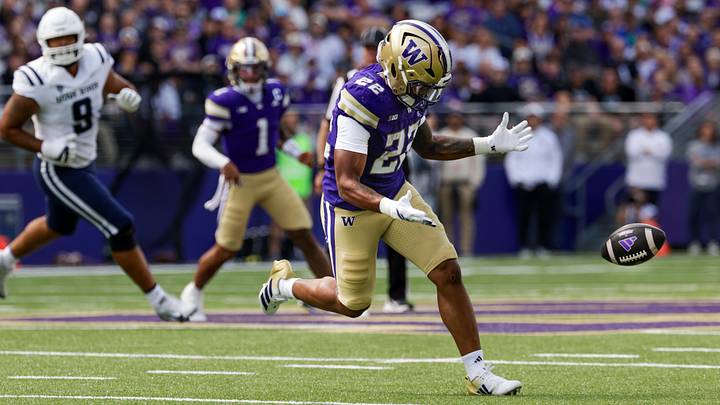
The injuries to Washington’s running back room are officially a major problem.
After losing running back Jordan Washington to a neck injury in the spring, and then losing both Quaid Carr and Jayden Limar against Washington State, the Huskies needed their younger, less experienced backs to step up on Saturday.
That didn’t happen. Instead, Washington’s offensive issues were laid bare on an afternoon which saw the Huskies barely eke out a 16-14 win over 0-1 Utah State. Washington’s injury-ridden rushing attack failed to impose itself on the Aggies, and instead forced quarterback Demond Williams Jr. to carry UW’s offense.
Williams was the only UW rusher to tally more than 20 rushing yards in the first half, with running backs Trey Cooley, Brian Bonner Jr., and Ansu Sanoe combining for just 37 yards on 12 carries across two quarters.
UW’s third quarter was even less productive, with the Huskies tallying just two rushing yards on their first seven carries of the second half. It wasn’t until the last play of the third quarter, when Williams broke loose for a 36-yard scramble, that any Husky recorded a run of more than 10 yards.
Huge 36-yard scramble for Demond Williams. Prior to that run, the Huskies third-quarter rushing offense had tallied seven carries for two yards.
— Beck Parsons (@BeckParsons3) September 12, 2026
Then, with a 13-7 lead and 10 minutes remaining, Washington’s lack of a run game prevented the Huskies from draining the clock efficiently. The team’s first potentially-game-sealing drive went six plays without a traditional run, and ended when Sanoe was stonewalled on third-and-2 to force a Tyler Robles field goal. UW was similarly unable to run the ball following the two-minute warning, and though the decision to throw on first down didn’t help, the Huskies were still given two more (ultimately fruitless) opportunities to convert on the ground.
Can the Huskies trust anyone but Demond Williams Jr. to carry the football?
Williams led the Huskies’ rushing attack for a second straight week, finishing with 56 yards on 11 carries. He tallied seven carries for 61 yards a week ago, and through two games leads the team in total rushing yards (117) and rushing yards per carry (6.5).
How bad is it behind Williams? Pretty bad.
Across two games, UW’s healthy running backs have taken a combined 25 carries for just 50 yards. Take away Trey Cooley’s 10-yard run from Saturday–the group’s longest carry by five whole yards–and the active unit is averaging an abysmal 1.6 yards per carry.
So who do you trust going forwards?
Cooley led the Huskies’ backs with seven carries for 22 yards on Saturday, but he also had one of the game’s biggest blunders: He dropped a wide-open pass on fourth-and-2, turning a possible touchdown into a definite turnover. Meanwhile, Bonner Jr.’s nine carries for 22 yards weren’t any more impressive than Cooley’s, and although Sanoe did find the end zone in the second quarter, the 240-pound bruiser finished with just five yards on five carries.
Unfortunately, Washington’s rushing struggles can’t just be blamed on the backs. Not a single one of the Huskies’ five offensive linemen earned a Pro Football Focus (PFF) run block grade above 56.3 on Saturday. The offense has also lost a starting caliber receiver early in back-to-back games, and the passing game has been further hampered by inaccurate throws from Williams.
“We’re not scoring, we’re not making those plays,”Jedd Fisch said postgame. “And on top of that, we’re just not getting into a rhythm…I think it’s on all of us to get into a rhythm.”
It’s been a less than ideal start to Fisch’s first season without an offensive coordinator, but the Huskies’ next offensive test is a fairly easy one. The Eastern Washington Eagles are 1-2 this season, and on Saturday allowed the victorious South Dakota Coyotes to run for 272 yards and two touchdowns. A dominant showing for the Huskies at home next Saturday could provide exactly the kick-start Washington’s sputtering offense is looking for.
 Add us as a preferred source on Google