

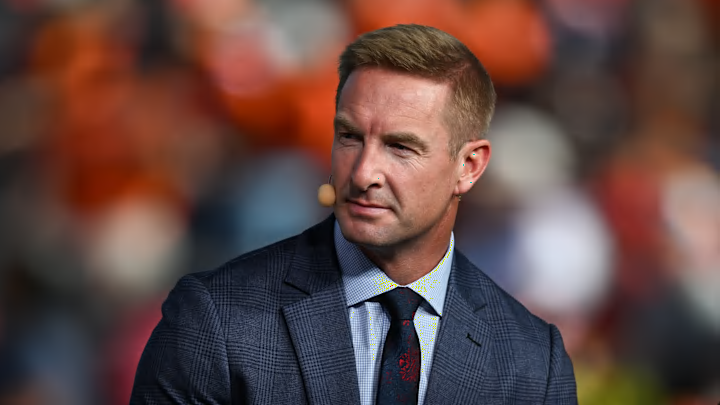
Washington quarterback Demond Williams Jr.’s decision to transfer in violation of a previously-signed agreement has taken the college football world by storm. FOX Sports commentator and analyst Joel Klatt, who was asked about the situation on Wednesday’s episode of Brock and Salk, heavily critiqued the move and the precedent it sets:
"I feel really bad for Washington in this scenario, I think Demond Williams is getting bad advice and I think that there is MAJOR tampering going on." 👀@joelklatt reacts to the news of UW QB Demond Williams Jr. entering transfer portal w/ @BrockHuard & @TheMikeSalk. pic.twitter.com/zS3UymWajp
— Seattle Sports (@SeattleSports) January 7, 2026
“This is part and parcel to everything that’s wrong, right now, with college football,” Klatt said. “How can we be in a situation where contracts don’t matter?”
Four days before Williams Jr.’s decision to transfer was announced, he and Washington came to terms on a revenue-sharing agreement which would keep the rising junior in Seattle through 2026. Williams Jr.’s departure—reportedly the result of a superior financial offer made by another school—violates that agreement, and has prompted Washington to pursue legal action similar to Wisconsin’s ongoing tampering suit against Miami.
“I feel really bad for Washington in this scenario. I think Demond Williams is getting bad advice,” Klatt said. “I think there is major tampering going on, rampant [across] the entire sport. It’s not specific to this case, but certainly [is happening] in this case.”
The former Colorado quarterback didn’t list any programs by name, but stated that there are “some desperate teams out there” who are willing to spend “obscene and emotional money” to fill gaps at the quarterback position.
Could collective bargaining prevent these situations?
Klatt also called for a sport-wide change to the way college football currently plays its players. In a college football world where most confusion is settled on a lawsuit-by-lawsuit basis, Klatt voiced support for a collective bargaining agreement (CBA). Such an agreement would unionize players nationwide and install a set of uniform rules regarding revenue-sharing between schools and athletes.
“If we’re not going to get federal legislation to help with guard rails and everything that we’re dealing with in college football, then we need a collectively-bargained agreement so that we can prevent things like this,” Klatt said. “When’s the last time you heard of anything like this?”
Athletes.org, an association with goals of creating a national union for college athletes, recently released a 35-page framework which outlines what such an agreement could potentially look like. The proposal aims to unify collegiate athletic compensation into a single income stream, doing away with NIL-based payments in order to establish “a fair and practical structure for athlete compensation and negotiations.”
The college football landscape has changed drastically following rapid-fire introductions of the transfer portal and NIL systems. If the NCAA wants to avoid catastrophes like the Williams Jr. situation going forwards, it may want to consider collectively bargaining with its players.
 Add us as a preferred source on Google