

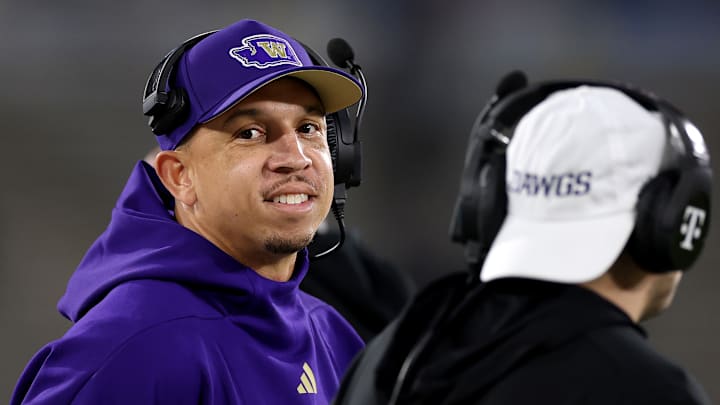
Ryan Walters came to Washington in 2025 for his first season as the Huskies' defensive coordinator, replacing Stephen Belichick on Jedd Fisch’s 2024 staff after Belichick left for the same role at UNC alongside his hall-of-fame dad.
Walters was previously Purdue’s head coach in 2023 and 2024 after successful defensive coordinator stints with Illinois and Missouri, but after leading the Boilermakers to just a 5–19 record in two seasons, he was fired. Thus, the UW defensive coordinator job became a genuine chance at redemption for the 39-year-old -- and in 2025, he delivered steady improvement that now earns its own report card.
It's important to look at the Huskies defense's previous season as a measuring stick for how Walters did. Leading a defense mostly composed of returners from the 2023 team that made a run to the national championship, Belichick's system allowed opponents to score 23.8 points per game, 54th in the nation.
While that's certainly not a stat to write home about, it was still an improvement over 2023’s 14–1 squad -- and for the first time in years, Washington’s defense outperformed its offense, which stumbled to 104th nationally in 2024. Even so, the unit left clear areas to improve.
Enter Walters, who was tasked with the responsibility of leading that improvement while also navigating the pressures of higher team expectations, most key players from the previous season's defense departing, and his own coaching career in flux.
So, how did he do? To put it simply: pretty good. The Huskies ranked 22nd in the nation with 19.4 points allowed per game, which was the program's best mark since the 2019 season. Although the Huskies' hype for this season stemmed from their high-powered offense headlined by Demond Williams Jr., Denzel Boston, and Jonah Coleman, the defense actually ended up ranking slightly higher, as the Dawgs were 23rd in scoring.
Washington Defense Rankings:
— HuskyFanPodcast (@HuskyFanPodBDTW) December 3, 2025
FEI #24, KFord #21, S&P #14, EPA? #25
2026-
-Full season of Manu, Deuce Davis, Jayvon Parker
-ZRS becomes star
-Add pass rushers in portal
-2nd year in Walters' system
Strong potential to be Top 15
However, it's worth noting that Walters' defense wasn't necessarily a consistent, dominant force all season. It took awhile for things to kick in to full gear, and the slow starts that plagued Washington's offense throughout the year also showed on defense.
In the very first game of the season, the defense allowed a Colorado State team that ended up going 2-10 to hang around for three quarters despite a flawless offensive performance. The same was true during the Apple Cup only a few weeks later, when fans were largely upset with Walters' scheme that allowed the Cougars to march down the field without resistance at times.
Yet still, the defense ultimately made big plays to seal both of those games, while also being Washington's bright spot in several others. None of the Huskies' four losses could be blamed on the defense, as it held No. 1 Ohio State to just 24 points, -- its second-lowest total of the regular season -- and kept Michigan to 24, Wisconsin to 13, and Oregon to 26 in games that were defined far more by UW’s sputtering offense than by any defensive shortcomings.
Washington's three-game stretch of Wisconsin, Purdue, and UCLA at the back end of the season is where the defense really shined -- allowing 14 points or less in each of those contests. Transfers like safety Alex McLaughlin and linebacker Xe'ree Alexander asserted themselves as leading tacklers, while true freshmen like linebacker Zaydrius Rainey-Sale and Dylan Robinson showed that they are impactful pieces of the future.
Additionally, Walters and his unit effectively handled injury losses to major contributors. Linebackers Jacob Manu and Taariq Al-Uqdah, thought to be two of the team's best defensive players, missed most of the season. Star cornerback Tacario Davis only played seven games.
Still, the defense had glaring issues that demand attention moving forward. Washington excelled at bending without breaking, coming up big on fourth-and-short stops and forcing opponents to settle for field goals on drives that should have produced more.
But that resilience masked a major problem: the unit simply didn’t generate enough disruption. The Huskies finished with just 14 takeaways (nine interceptions and five fumble recoveries), a total that ranked 77th nationally.
Even more concerning was the pass rush, which once again lagged far behind conference and national standards. With only 21 sacks (tied for 92nd) and 51 tackles for loss (120th), the Huskies struggled all season to pressure opposing quarterbacks.
The lack of punch from the defensive line was consistently frustrating, and finding a true game-changing edge rusher has become one of the program’s most urgent needs heading into 2026. Hopefully Fisch and Walters can find one or two in the transfer portal, along with other defensive positions to replace departing seniors.
If that can happen, Walters can ride on the momentum he built at the end of the 2025 season with another offseason of development for the defensive returners. It really seems like he's figured things out after a shaky start, and it's good to be in a position where you have a top-25 defense with clear areas to improve at.
Defensive coordinator Ryan Walters' 2025 grade: B+
 Add us as a preferred source on Google